

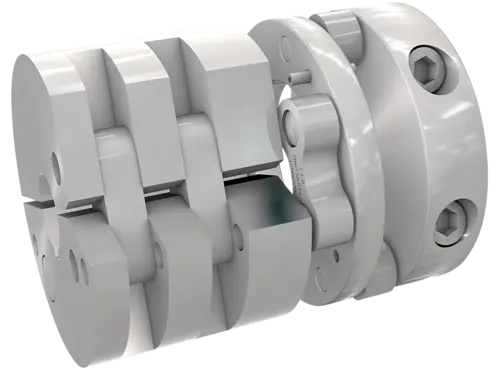

Extremely confined installation spaces, lightning-fast changeover times, the accommodation and connection of extra-large shaft diameters, or the adaptation of couplings using customer-specific adaptors, pins or space-saving, internal clamping sets – all these requirements place high demands on a bespoke coupling solution.
Our options for the technical implementation of your specific requirements are virtually unlimited. Below you will find examples of customised adaptations and specially tailored solutions based on the conditions relevant to your application.
Extremely space-saving design in the manufacture of vehicle restraint systems
Vehicle restraint systems in the form of extremely high-performance safety barriers offer a high level of safety for vehicle occupants in the event of a collision, thanks to their high efficiency. But how are these protective devices manufactured, which offer such sophisticated protection despite their low weight?
Case study:
Extremely compact and high power density
Profiling systems are the solution here. In a multi-stage forming process, these shaping systems produce the corresponding continuous box and lattice profiles. Thanks to its high radial displacement capacity, the slimline Semiflex precision coupling proves to be the ideally suited partner for the various functional adjustment movements involved in the forming process.
Its compact design enables the various profiling stations to be connected in the tightest of spaces. To cope with the very restrictive installation conditions, the coupling is fitted with friction-lock internal clamping sets.
Semiflex
- Size C 2390
- High power density: outer diameter 180 mm, overall length 126 mm, max. torque 5.855 Nm
- Internal clamping sets
Quick roller changes in decorative printing systems
Furniture with a wood-effect finish can be found in almost every home. Some people prefer pine or chestnut, whilst others favour maple or beech, to create a cosy atmosphere within their own four walls. Yet much of this furniture gives a more impressive appearance than it actually is. They owe their wood-effect appearance to decorative films, which are applied to the surfaces of chipboard or other substrate materials and give the impression of real wood. The quality of these decorative films is often so high that the ‘printed’ pieces of furniture are almost indistinguishable from real wood products.
Case study:
Swivelling clamping screw unit ensures the fastest changeover times
A paper printing system for furniture surfaces had to meet high productivity requirements. The focus was on flexibility when printing a wide variety of wood finishes, which meant that quick changeovers of the printing rollers had to be guaranteed. A special version of the torsionally rigid Semiflex coupling provides the solution here. To ensure that the various printing rollers can be changed quickly, the coupling is designed on one side as a ‘swivelling clamping screw unit’. By simply loosening the relevant clamping screws, the coupling lock can be raised from the operator’s side using a hinged joint. The screws remain in the other part of the clamping unit and do not need to be removed. Thanks to the special design of this hub shape, the clamping mechanism remains in the raised position after opening and cannot snap shut. An additional wear-resistant surface coating on the coupling rounds off the customised package.
Semiflex
- Size F 320
- Hinged latch for quick changeovers
- Additional surface hardening through nitriding
Extremely confined installation conditions in folding carton gluing machines
Corrugated cardboard packaging is indispensable as protective outer packaging. The manufacturing process for these lightweight yet sturdy products usually takes place on in-line machines comprising several sub-units. These sub-units produce the finished corrugated cardboard packaging from sheets of cardboard. In the process, the sheet passes through the individual stations – the feeder, printing, creasing and slitting units, and the die-cutting and folding station – before finally being transformed into a finished package in the folding carton gluing station.
Case study:
It doesn’t get any shorter than this: operating principle integrated to meet specific customer requirements
In such packaging machines with extremely compact installation conditions, the torsionally rigid Semiflex precision coupling supports the synchronised sequence of operations across the individual processing stations. To achieve the shortest possible coupling solution, the coupling was designed as a 1/3 solution. The offset centre disc with the parallel link system, together with the corresponding mounting components, was precisely integrated into the tightest of spaces within the customer-specific mounting components.
Semiflex
- Size C 230
- High power density: outer diameter 90 mm, overall length 17 mm, rated torque 230 Nm
- Radial displacement of up to 4 mm
Specific metrological requirements regarding installation situations
The demands placed on an encoder coupling are high. It must operate with precision and angular synchronisation, and compensate for any misalignment with minimal restoring forces so as not to place a strain on the precision bearings of the transducers.
In the case of more complex and challenging customer-specific requirements, customised modifications to the Controlflex rotary encoder coupling allow it to be adapted to the respective application. This may be the case, for example, with special installation situations or direct connection to the customer’s own components.
Minimum shaft spacing, even with large shaft diameters
In some applications, for example, the shafts to be connected are positioned very close to the end face. This situation does not pose a problem with small shaft diameters. The central bore of the functional element allows the shafts to be inserted into the interior of the coupling whilst simultaneously compensating for shaft misalignment. For shafts whose size is close to the maximum permissible bore diameter for the coupling size, the coupling specialist equips the rotary encoder coupling with a modified functional element. The extra-large central bore is adapted to the shaft diameter, thereby enabling this installation scenario to be realised.
But how can requirements be met where the shaft to be connected significantly exceeds the maximum permissible bore diameter for a given coupling size, whilst an existing limited installation space precludes the selection of the next larger coupling size for dimensional reasons?
Case study:
Mounting extra-large shafts using special clamping hubs or adaptors
This can be the case, for example, when the coupling is mounted on the encoder side in a bell housing or where there is limited axial clearance. In one application, the CPS 15.1 size was the optimal choice based on the performance parameters and dimensions. With a diameter of 24 mm, the output-side shaft to be connected exceeded the maximum permissible bore diameter for this coupling size. In line with the aforementioned requirement, Schmidt-Kupplung designed a coupling variant featuring a special clamping hub on one side. On the drive side, this features a standard clamping hub with a diameter of 37 mm, whilst on the output side it has a clamping hub with an outer diameter of 56 mm and a length of 15 mm. The special clamping hub is fitted with pin bores positioned according to specific coordinates to accommodate the functional element. This design therefore enables the oversized shaft diameter to be accommodated and connected in a manner suited to the installation space.
The accommodation of very large shaft diameters is made possible by versions with a customer-specific adapter.
Controlflex
- Versions for extra-large shaft diameters
- Adaptation with a customer-specific adapter
Radial mountability in high-precision coating systems
Roller coating machines are flexible and versatile, suitable for applying a wide variety of coating materials – such as glues, oils, glazes, primers, synthetic resins and adhesives – to flat, level substrate materials. High-precision stroke adjustment units enable the exact setting of the desired clearance heights.
For specific installation conditions in these systems, the Schmidt coupling, with hub designs specifically engineered for this purpose, forms an integral part of the drive train. Clamping hubs in a half-shell design or connection via pins are just a few examples.
Schmidt coupling
- Shaft connection via a customised clamping hub in a half-shell design
- Easy to dismantle thanks to a centring pin connection